

STS Container Crane Fundamentals Explained
Containerization has been a pivotal factor in enabling globalization. It continues to play an integral role in the global supply chain. The concept of containerization was introduced in 1956 by Malcolm McLean. Before containerization, offloading cargo was a very slow and burdensome process. When container cranes were introduced, they reduced the cost of imports from $6.48 to $0.16 per ton. Containerization and container cranes were the engineering breakthrough that made globalization economical.
Container cranes typically require structural engineers to ensure the structure is robust enough for its service class; mechanical engineers design the power transmission systems; and electrical engineers for controls and power. Container crane design requires a multi-discipline team of engineers. There is some overlap between disciplines. For example, mechanical engineers can be educated on both control theory and strength of materials.
Types of STS Container Cranes
Container cranes have several common structural and mechanical arrangements. Here we will discuss a few historical examples and the most common structural arrangements. Specifying the optimal arrangement during the procurement process is vital for the success of the terminal.
A-Frame Container Cranes
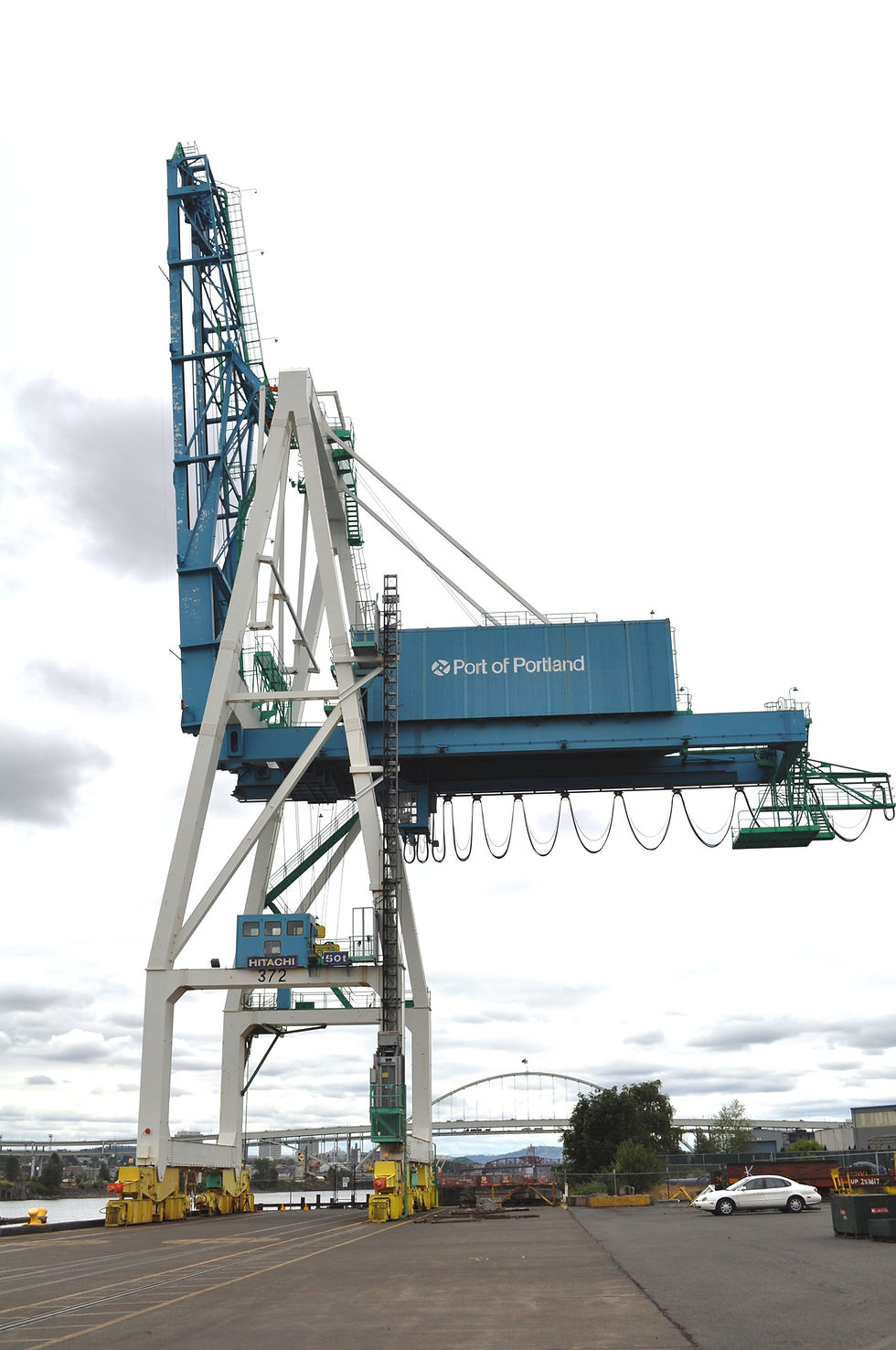
A-Frame container cranes were the initial design concept. This type of crane is rather rare now as it does not scale in size as well as the other designs. As the name suggests, the primary structural frame looks like the letter A.
H and AH Frame Container Cranes
The next iteration was an H frame which has vertical legs that do not taper in. While this layout scales well as the rail gauge and lift height is increased, some terminals do not have a sufficient setback distance. Small setback distances introduce a risk of the vessel contacting the waterside leg.

To mitigate the risk of contact for small setback distances a hybrid design, AH, was introduced. AH frames taper the waterside legs away from the vessel which increases the clearance between the legs and a berthed vessel with a small list (typically 1 degree). The major drawback of the AH frame is that it complicates the manufacturing process. The tapered waterside leg also complicates stairway and access considerations.

Shuttle Boom Container Cranes
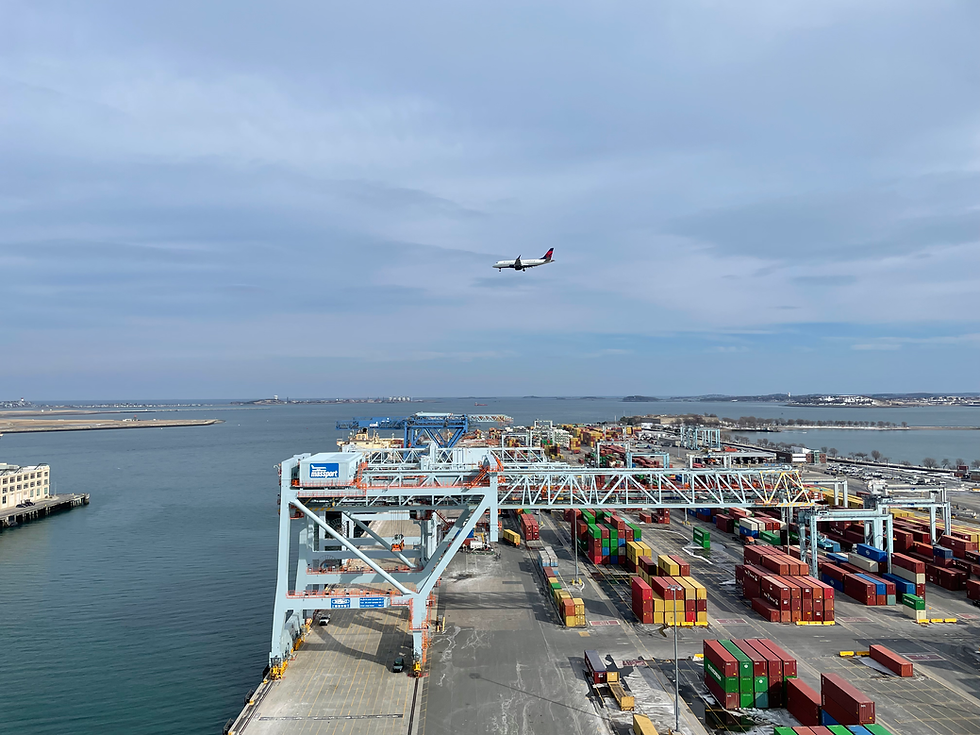
Shuttle boom cranes are popular where the overall height of the cranes is restricted. The most common source of a height restriction is a nearby airport. Rather than rotating the boom up, the shuttle boom rolls in and out between the operating and stowed positions.
Articulating Boom Container Cranes
An articulating boom, also commonly referred to as a goose-neck, has two hinge points along the boom. The extra hinge point allows for a more compact stowage configuration. The articulating boom is another solution for cranes with restricted overall height. The main advantage over the shuttle boom is that it will weight less, however the disadvantage is that the overall crane height will be greater than a shuttle boom for a given lift height. Another disadvantage is that because the boom still sits over the berth it may restrict vessel size.

Basic Vocabulary
Containers
COC (Carrier-Owned Container) – Container owned by shipping line.
Dry Container – Standard non-refrigerated container.
Forty-foot Container – Equals 2 TEUs (1 × 40-ft container).
High Cube Container – Taller container (typically 9’6” height).
OOG (Out of Gauge) – Cargo that exceeds standard container dimensions.
Reefer Container – Refrigerated container for perishable goods.
SOC (Shipper-Owned Container) – Container owned by shipper, not carrier.
TEU (Twenty-foot Equivalent Unit) – Standard measure of container capacity (1 × 20-ft container).
Vessel Types & Size Classes
Feeder Vessel – Small ships (~1,000–3,000 TEU) serving regional ports.
Feedermax – Larger feeders (~2,000–3,000+ TEU).
New Panamax (Neo-Panamax) – Fits expanded Panama Canal (~13,000–14,500 TEU).
Panamax – Max size to transit original Panama Canal (~4,000–5,000 TEU).
Post-Panamax – Too large for original canal (~5,000–10,000 TEU).
ULCV (Ultra Large Container Vessel) – 18,000+ TEU
Port and Terminal Infrastructure
Air Draft – Height from waterline to highest point of vessel.
Batter pile – A deep foundation pile driven into the ground at an angle rather than vertically.
Berth – Specific docking position in a terminal.
Brownfield – Expansion or redevelopment of existing facility.
Draft – Depth of water needed for a vessel to float safely.
Hatch Cover – Removable steel covers over cargo holds on container vessels.
Intermodal Transport – Movement using multiple transport modes (ship/rail/truck).
Gateway Port – Entry/exit point for inland cargo.
Greenfield – New development built from scratch (e.g., new port terminal).
Marginal Wharf – a docking structure constructed parallel to the shoreline, connected to the land along its entire length, rather than extending outward as a pier. It serves as a continuous quay for mooring vessels and handling cargo, commonly found in port terminals to maximize berthing space along a bank.
Quay (Wharf) – Dock where ships are berthed.
RMG (Rail-Mounted Gantry Crane) – Crane on rails in terminals. Often used in intermodal transport to transfer containers to railcars.
RTG (Rubber-Tyred Gantry Crane) – Yard stacking crane.
STS Crane (Ship-to-Shore Crane) – Used to load/unload containers.
Yard – Storage area for containers in port.


